
Good questions. Long(ish) answer. Sit down for this one.
I was sent a DM recently after I wrote a bit of a thing about Motiva Preservé.
.jpeg)
That lead to a bit of a conversation, but I thought it was worth exploring in a bit more detail.
Whilst this question asked me specifically about Mentor implants vs. Motiva implants, we can consider other implant brands as well, because in many respects implants are best categorised by surface treatments and shapes and there is often significant overlap between different brands. Brand loyalty has historically been dependent on two things: price, and assessment technique (I'll explain what I mean below).
But rather than jumping straight into any discussion about surface treatments, manufacturing, silicone polymerisation, or any other bit of science-y stuff, we can actually look at this more as a question of marketing, branding, training and trends. Arguably, in fact, the science has very little to do with it. Alas.
Also, before anyone gets excited and says "hang on you say you don't do primary breast augmentation, why are you talking about breast implants", well whilst that is true, I still use breast implants for a range of cases, including in reconstruction, in revision cases, and for certain types of breast surgery (like tuberous breast correction) where implants remain a necessary choice. Just because I choose not to do primary breast augs doesn't mean i think implants are bad or evil. I just happen to think that a lot of breast augmentation procedures are done (really) badly, which is a different thing.
The 1990's: the first link between pre-op assessment, surgical technique, and implant choice.
We need to start by winding back a bit – we’re talking late 90's here. What a time to be alive! Great hair, brick phones, grunge, strangely tight T shirts with very large pants...ahh the memories. Gen Z…relax, we don’t expect you to know what we’re talking about, it won’t be on the quiz.
The implicit (and sometimes explicit) link between implants and surgical technique/training arrived with the introduction of the form stable, anatomical shaped breast implants. So we’re talking here about Allergan (formerly McGhan) style 410, and the Mentor CPG range.
These two brands really owned the implant space from around this time right up until the car crash of 2018 when a bunch of implants were recalled – we’ll get onto that later. It was a 20 year bull run for these two companies. Not bad, but a great example of marketing over science.
Anyway, prior to the introduction of the anatomical devices, we only had the traditional “round” breast implants. With the round devices, the variables are base width (which is the same as height) and projection. The anatomical implants introduced the ability to modify height independent of base width, as well as projection. And they introduced a whole new concept of breast augmentation assessment and planning that, prior to that, had never really been codified.
In the first few decades of surgical practice with breast implants, it is safe to say that things were a bit...loose...when it comes to how breast augmentation was assessed, measured and performed. What that meant was that patients got a decent result if they happened to have a well shaped breast before surgery, the scar could be made in the crease, and a suitably sized implant would then "fit" into the breast. But that certainly wasn't all patients. There were invariably women who didn't have the length in the lower pole for their implant size, whose nipple position was not properly centred over the implant volume, who had minor tuberous differences that weren't considered, who needed a combined mastopexy but didn't get one...
But with the introduction of the anatomical implants, we saw the first efforts at formalising the assessment of the breast in order that the implant did "fit" correctly. Two big names, Dr John Tebbetts (the true originator of the "dual-plane" technique - the paper, published in 2001, is something of a classic doi: 10.1097/00006534-200104150-00027) and Dr Per Heden, were instrumental here. Tebbetts introduced what he called the Hi-5 method of assessment, and Heden introduced the AK method. Both were similar in what they were trying to achieve. Both were then linked to the technique of performing breast augmentation - the first time that assessment and technique were introduced as two integral aspects of achieving reproducible results. Both revolved around dual plane placement of anatomical breast implants.
And perhaps this is a point worth considering: given that up until this moment there were no clearly defined techniques of assessment, and similarly no rigorous techniques of performing the surgery, once this was introduced to create reproducibility, is it any wonder that surgeons jumped at it? And is it any wonder too that becuase they learnt these techniques that gave them reliable outcomes, that surgeons would then become rather attached to the idea of dual-plane breast augmentation too?
It was then with a true focus on making sure that the implant "fit" the chest that we saw the real push (and the associated marketing) towards the use of variable height anatomical devices.
So we all of a sudden can link an assessment technique, with a choice of implant, AND a surgical technique. And once linked, those things have been incredibly difficult to decouple over the following years.
And this then lead to the first era of implant brand loyalty.
The interesting thing about Allergan style 410 anatomical implants, when compared to the Mentor CPG devices, is that whilst they are both similarly shaped, there is a major difference in terms of where the "point of maximum projection" of the implant sits. And what this meant was that surgeons had to use slightly different forms of assessment, measurement and implant placement to suit those implants. Which of course meant that typically, surgeons would get used to using one implant and not the other...and so they continued to do so.
There was a period between about 2007 right up until the recall of the Allergan devices in 2018 during which surgeons were quite firmly wedded to either Mentor or Allergan, and very rarely did surgeons use both brands.
Of course, it wasn't just Allergan and Mentor; there were other brands floating around too. The less prevalent brands were normally European or South American, and typically presented at a lower price point, which meant that those devices were predominantly in use by those disreputable "cosmetic doctors" (you know, the ones who used to call themselves "cosmetic surgeons" but who have no surgical training or qualification...the ones who can't work in real hospitals so end up doing their shitty work in some dicey chop shop day surgery...yeah, those ones) whose idea of good business was the cut-price, all inclusive breast aug for $4999. To be fair though, cheap implants were pretty bloody common here in my home town of Adelaide as well - but I put that down to the historical determination of people from Adelaide to do things differently to how they were being done in Melbourne (and bugger it if the way it was being done in Melbourne was actually better, the Adelaide folk would still do it differently). Love you Adelaide (mwah)!
Anyway, we're talking here about brands like Nagor, Silimed, Eurosilicone, CUI...most of which were a good bit cheaper than the Allergan and Mentor products. And let's not forget the glory days of PIP implants: Poly Implant Prosthese was a French company making implants from non medical grade silicone. They tended to rupture very quickly. They were cheap. There were quite a few put in. Hell, I saw a lady not long ago who still has hers in. Oh well.
The Instagram age: the 2010's
Instagram has been a remarkable force acting on the plastic surgery industry.
The early days of istagram were a real time-stamp. All you young folks would have no memory of this, but way back in the day, instagram was fundamentally a place were it was all "still" images (no reels kids), and your feed was literally only the accounts you followed.
Arguably, the way surgeons behaved back then was...(even more) problematic.
Many years ago, I was a member of the Society of Aesthetic Plastic Surgeons (ASAPS, here in Australia). I have long since dissociated myself from that society, but the main reason for doing so (this was about 10 years ago now) was becuase certain surgeons had decided that Instagram was a place to post their results like some sort of soft porn magazine...it was all soft filters, lingerie, patient-submitted smut...honestly it was weird. There were (and indeed still are) surgeons who really encouraged this sort of cultish vibe where the doctor-patient boundaries didn't just blur, they completely vanished!
Anyway, there was a bit of a stink at the time in the media about the behaviour of some surgeons, and in a television interview, the former president of ASAPS made the following comment: "A post that is 100% ethical may be 100% ignored".
That was the point that I realised that a whole section of the plastic surgery community had abandoned any pretence at the practise of medicine. As soon as these surgeons decided that likes and follows (never mind the rather loud whispers that certain players had "bought" most of their followers lol) were the (only) goal, I realised that ASAPS was not a professional society for me.
But to get back to my main argument, this era also lead to the wider public understanding and awareness of implant brands. Prior to that, patients never really had an awareness of what implant was being used...they just went in to see a surgeon, picked a size, got an implant and away they went. But in the post-instagram age, brand awareness became part of the online dialogue as patients increasingly discussed their procedures in forums and on socials.
The post-recall era: the end of texture?
So instagram and the cult-y vibes of a few popular surgeons really maxed out the breast augmentation market towards the end of the 2010's. It was peak side-boob, under-boob, "one finger" cleavage, and really tiny bikinis that barely covered the areola.
Blame the Kardashians, I dunno.
Anway that kinda all came to a crashing halt around 2018 when the whole ALCL thing hit popular awareness.
Quick refresher: back around 2016, a rather obscure thing called "breast implant associated anaplastic large cell lymphoma" came to a certain kind of prominence. BIA-ALCL was, and remains very rare. However, it is fundamentally associated with the presence of a textured surface breast implant. If you don't have a textured implant (or haven't had one previously) you can't get it. If you have only ever had smooth implants, or "nano" textured Motiva implants, you can't get it.
Which put a hell of a dampener on the whole textured anatomical implants schtick that was essentially status quo for most Australian plastic surgeons. Bugger.
The other thing that was important to note was that risk was directly linked to the type of surface texture - the more "aggressive" the texture (read: Allergan macrotextured and Silimed Polyurethane coated devices), much higher risk of BIA-ALCL. The less aggressive Mentor surface texture however was associated with a significantly reduced risk in comparison. So, that was then followed in 2018 by a whole sequence of voluntary product recalls which removed many of the existing breast implants from the market. And with the disappearance of those implants, we also saw the disappearance of much of the market for breast augmentation that relied on texturing - which means, the narrative around anatomical breast implants literally vanished overnight. That has certainly lead to a shift in how surgeons who continue to use anatomical devices justify their ongoing use.
Motiva and ALCL: right product, right time, mostly luck.
Now, while the whole ALCL thing was blowing up and became a curious focal point of plastic surgery for a year or two (despite its rarity), something was happening kinda in parallel (and had already been happening well before): Motiva (Establishment Labs) had been working away on their "new" nanotextured surface which, at that time, had never been seen.
This is the part where we can get a little nerdy, but I don't want to over do it.
Suffice it to say, prior to the development of the "Silk Surface" of Motiva implants, we can basically assign breast implants into two groups: smooth, or textured. There was some suggestion that textured implants decreased contracture rates, but as I have made very clear in previous articles, this evidence was sketchy at best, and involved very problematic historical data comparisons.
The development of "nanotexturing" was the first genuinely new innovation in implant surfaces in about 30 years. It is a rather fascinating process which, if you go and read the original patents, involve some pretty incredible stuff by comparison to the older style textured devices.
In the various efforts at managing the issue of capsular contracture, one of the very few interventions which appeared to offer reproducible benefits was the use of "acellular dermal matrices" (ADMs), rather than a specific implant surface. For many years, surgeons had avoided the removal of implant capsules (in revision cases) due to perceived risks. But they had tried various releasing techniques to allow tight capsules to expand. They found that if the capsule was incised, it would happily pop open to allow an implant to sit there without constriction, but the contracture would rapidly recur. Then a few folks noticed that if you made those same incisions, the capsule was expanded, and then a piece of ADM was stitched into the gap, the risk of recurrence appeared to go down. Eventually, people started taking the entire capsule out, and completely wrapping a new implant in this ADM before placing it back into the breast, with appreciable differences in the risk of contracture. This same technique has also been applied widely in the context of breast reconstruction after mastectomy, which is an environment far more predisposed to contracture than cosmetic breast augmentation.
Anyway, the observation that ADM appeared to inhibit the tendency for scar capsules to contract was instrumental it seems in the development of nanotextured breast implants.
A rather smart guy called Ardeshir Bayat at the University of Manchester, decided to use some pretty serious tech to image, and then replicate the "nano-scale" features of ADM (http://dx.doi.org/10.1016/j.biomaterials.2015.02.003). Basically this involved processes similar to how modern silicone microchips are manufactured - atomic force microscopy, laser photolithography and deep reactive ion etching. These rather fancy words can be boiled down to this: they took pictures of ADM at the nanoscale, allowing the specific surface topography to be identified at something close to molecular level and this topography was then "printed" in silicone to create an entirely novel implant surface.
Now, that alone is really very cool.
What followed took that very cool technological achievement and demonstrated something never seen before: the "nano-scale" surface texture, when exposed to the cells that form implant capsules, stimulated behaviour in those cells that was totally unlike any other implant.
I know I said I wouldn't get too science-y with this, but bear with me.
Essentially, the main cells that are responsible for the formation of implant capsules are called fibroblasts. On normal breast implants, whether smooth or textured, fibroblasts tended to clump together and take on certain shapes under the microscope; and the behaviour of those cells, in such configurations, was associated with the release of a whole bunch of chemicals and growth factors that all contributed to the progressive tightening of the generated scar capsules around implants. The reason this can happen is because the fibroblast cells are much smaller than the scale of texturing of Mentor or Allergan implants and so if you zoom right in, those textured implants have very large flat areas where the cells can congregate, at which scale the implant actually looks smooth.
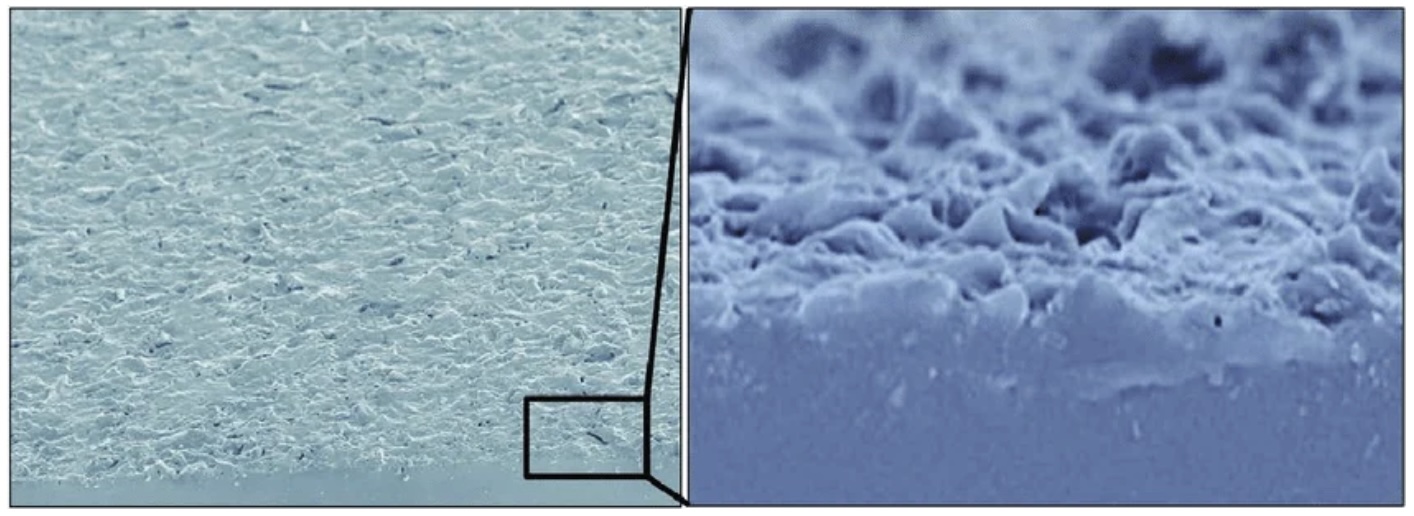
However, those same cells, on the surface of the nanotextured silicone, did something radically different. Because of the scale of the surface texture (about 4 microns for Motiva implants), there were multiple little surface "spikes" under each cell - each fibroblast ranges in cell size but can be about 20x80-200 microns (they are much longer than they are wide). This allowed the cells to have contact with each of these little spikes (think of it like those flip-flops with tiny little rubber nodules on the footbed, which people wear to "massage" their feet - if you're old like me and you went to university in Queensland in the late 90's, you'd be familiar with the old-school Masseur sandals that were oddly popular in certain circles) and this multi-point contact actually triggered very specific signalling pathways that switched those cells...off.
Side note: you will notice that whilst the product marketing (and throughout this article) Motiva implants are referred to as "nanotextured", the actual measurements we are talking about are in microns, or micrometers. If we want to be picky, "nanotexturing" is a misnomer, and is just more of the typical implant marketing we've always seen. Nanometers and micrometers are separated from from each other by a factor of 1000! It is the equivalent of the scale difference between millimeters and meters. The problem (from a marketing perspective) is that the term "microtextured" already applies to traditional surface textures as used in Mentor implants (we'll get onto that in a sec).
What Dr Bayat and his colleagues had done was create an implant surface that your fibroblasts recognised as being less "foreign", and this resulted in those cells (which ordinarily were churning out the gear that lead to thick, hard scar capsules) kind of ignoring the implant. In practice, this means very thin capsules, with dramatically lowered rates of contracture.
Dr Bayat's work has since been licenced by Establishment Labs, the parent company of Motiva Implants, and Dr Bayat continues in a senior scientific role with those companies. The fact that the original research was financially supported in part by Mentor is just a curious little footnote at this stage, but I can't help but wonder what happened behind closed doors around the time that Dr Bayat's work was published. I mean, did Mentor turn this innovation down? Did they think it wasn't useful? Cos if that is how it went, they must be kicking themselves by now. Anyhoo...
Ok, so that tells us WHY Motiva implants were created. But it doesn't really tell us why they have now assumed market dominance. This is where the luck comes into it.
The luck was in the timing of arrival to market, and timing with respect to ALCL.
When ALCL was kicking off and putting the fear into plastic surgeons worldwide, it didn't take long - in spite of the rarity of the condition - for a very clear observation to arise: ALCL only occurs in the presence of textured breast implants, and the more textured the implant, the higher the risk of ALCL.
At this point, there was a collective sotto voce utterance of "oh fuck" throughout the plastic surgery industry (and I reckon there would have been some tears being shed all over the alcantara wrapped steering wheels of some rather nice cars).
The corollary of this observation being that women who had only ever been exposed to smooth implant surfaces simply did not appear to have any potential to develop ALCL.
Given the deep attachment of Australian surgeons to textured anatomical implants, this lead to two major issues: you can't have a smooth surface tear-drop shaped implant, and they couldn't go back to using smooth round implants when they'd spent the last 20 years telling everyone that smooth rounds were associated with higher risks of capsular contracture. So, they were stuck in a hell of a bind.
Enter, stage right: Motiva. Come check out our new implants, they said. They're not smooth, but they aren't textured. And whilst it wasn't known then but has since been clearly demonstrated: there is zero risk of ALCL with Motiva implants.
Talk about good timing.

Round, nano-textured implants are not the same as....anything that came before.
So, texturing is bad, right? And there were a bunch of recalls around 2018 that lead to many textured breast implants being withdrawn from the market in the wake of the whole ALCL thing.
But Mentor textured breast implants are still available. So what gives?
This is really a question of quantified risk. So, yes, textured implants are associated with a risk of developing ALCL. But it is not a uniform risk.
Ok so "textured" comes in a few different flavours. The typical definition of texturing depends on the "roughness" of that texturing. The roughness can also be interpreted as the scale at which contouring of the silicone shell exists. On that measure, we can then consider 4 different categories: macrotextured, microtextured, nanotextured, and smooth.
Now consider for a moment as well the way in which texturing is achieved. Traditional texturing involved two techniques, and helpfully for this discussion, one technique was used by Allergan (for their Biocell surfaces), and the other by Mentor (for their Siltex surfaces).
The largest scale texturing (macrotexturing) was attributed to something called salt-reduction. Basically, salt crystals were embedded the in silicone implant shell, and then at a later stage in production, the salt crystals were dissolved, leaving behind the cuboid shaped imprint of a salt crystal. Also relevant is the fact that the resulting indentation in the silicone left behind was narrower at the top than the bottom, which meant that with tissue ingrowth, a kind of dove-tail fusion occurred which accounts for why Allergan implants are often stuck to the capsule like bloody velcro!
The next scale down (microtexturing) was a result of an imprinting technique using a sponge of sorts - essentially, the silicone shell was stamped with this sponge before curing, which resulting in a debossed texture. This technique, used by Mentor, resulting in smaller indentations, which were also wider at the top than the bottom, which meant less tissue ingrowth and less adhesion (if any) between the capsule and the implant. In fact, we typically find that Mentor devices have no adhesion to the capsule at all, and a very slippery, fragile inner capsule surface - so much for the whole "textured implants are more stable in the pocket" argument.

So, these two traditional textures were both intended to stick to the tissues (but only one did), and both were intended to reduce capsular contracture rates (by the same purported mechanism, which was an increased surface area of the implant) which there was very little evidence to ever support, except in historical comparisons to smooth implants placed in the 70s and 80s. But clearly they were operating at different scales. And what we learned with ALCL, was the relevance of that scale difference. For whatever reason (and it still isn't clear), the macrotextured devices conferred a substantially higher risk of ALCL compared to the microtextured devices. And so, when the proverbial shit hit the fan, it was the macrotextured devices (Allergan) that were recalled, whereas the Mentor devices remained on the market. Importantly, Mentor still confers some risk of ALCL. It's a good idea not to forget that.
As it stands, we have 3 choices of implants currently on the market:
Whilst I refer to "other" brands, in reality, this is a two horse race. Mentor vs. Motiva. Everyone else is irrelevant in 2026. So whilst companies like Silimed, Nagor, and indeed even Allergan still exist in other markets, in Australia we have something of a duopoly.
So if we are asking why surgeons would choose one implant brand over another, right now in Australia we are asking why surgeons would choose Motiva over Mentor, or vice-versa.
Mentor vs. Motiva.
Ok. Direct comparison time.
Choose your fighter.
Mentor implants are largely unchanged over the last 20 years. Same products - smooth or microtextured, round or anatomical - same problems. Being the last man standing after the carnage of the ALCL-driven implant recalls is something I guess, but as far as product endorsement goes, it's hardly resounding.
Motiva implants offer something genuinely innovative, based on what looks to me like pretty rigorous lab science which has then been confirmed in trials and ongoing clinical use.
BUT...does that translate into better clinical outcomes?
Well, maybe, but not necessarily.
Mentor implants are a known entity for many surgeons. And if we're honest, a familiar product sometimes improves clinical outcomes for the simple fact that if a surgeon is comfortable using the device, then they may well have their assessment, planning and technical execution elements down pat. So jumping to a new device doesn't always lead to better outcomes in such circumstances.
And Motiva implants definitely have shown a fair learning curve for surgeons who trained/were taught with textured implants, and even old-school smooth implants.
What is interesting is that there are a bunch of surgeons who used to use textured Mentor implants, who now only use smooth Mentor implants. So, they have clearly determined that surface texturing is something they want to avoid given the ALCL risk, but instead of moving to a new device, they have reverted to an even older option. Which is interesting.
What we actually have now is 3 groups of surgeons:
For those three different groups, there are different ongoing challenges posed by the nature of the implants they are using. We can look at this in terms of shape, feel, positional stability, and long term behaviour.
Let's start with shape so I can get this out of the way first - as I have said many, many times before, the arguments for the use of anatomical implants I think can be thrown onto the historical dumpster fire of implant hocus-pocus that was so pervasive right up to about 2016. There has never been, and will never be, any evidence whatsoever to confirm the frequent assertions (by so many surgeons) that antomical implants offer a "more natural" result. It was, is and forevermore shall be bullshit.
...the arguments for the use of anatomical implants I think can be thrown onto the historical dumpster fire of implant hocus-pocus that was so pervasive...
However, those who persist in the use of anatomical devices also persist in the belief that anatomical devices serve a role, and this belief hinges on the idea that only anatomical devices allow a surgeon to use implants that have a different height compared to width. Which is true. But the question is why? Why would you want/need to use implants that are 1cm shorter than they are wide, for example? Does this translate into any sort of actual benefit? And the answer remains no - there is no evidence of clinical benefit at all.
But, beliefs are hard to budge, regardless of evidence, and so for surgeons who continue to think in these terms - and these surgeons will often trot out lines (hands up if you've heard 'em!) to breast aug patients like "building a breast is like building a house: you have to work within your block of land, but then you get to choose how many stories you build" - Mentor is the only company in Australia currently offering anatomical implants.
Now, in terms of feel, there are some differences to consider. Implant companies have always made a bit of a thing about this, and it was mostly confected garbage. However, there are actually some differences to consider between Mentor and Motiva. What this really relates to (I think) has more to do with the interaction between the silicone gel and the implant "shell" than it does with the specific formulation of the silicone gel - and this is rather contrary to what the implant companies like to claim.
So, the usual claim (for all the implant companies) is that their specific formation of polydimethylsiloxane (ie. silicone polymer gel - and they all do cute little chemistry experiments to alter the polymer length, or change the degree of cross-linkage between polymer chains, for example) creates the most "natural" feel. Yeah, right. Whatever. In reality, the "feel" of the breast always had more to do with the implant:breast tissue ratio. More breast tissue, less implant, more natural. Less breast tissue, more implant, less natural.
...the "feel" of the breast always had more to do with the implant:breast tissue ratio. More breast tissue, less implant, more natural. Less breast tissue, more implant, less natural.
BUT (!) there was also a role to play here from just how plasticky the implants felt, which really meant the feeling of the shell. So, the slightly more rigid shells that are found on the mentor implants had more of a tendency for them to feel crinkly, like a plastic water bottle, compared to the Motiva implants (which don't have a shell in the traditional sense as they are made as a "monobloc" - which means that the fill and the shell are all one and the same - rather than the traditional two part construction of separate fill and shell). Those more rigid Mentor shells (and this is true for both the smooth rounds and the textured anatomicals) also resulted in some (typically slim) patients feeling folds in the implant shell (typically in the lower, outer portion of the breast where there was the least tissue coverage) as something a bit pointy or even lumpy.
The third feature, positional stability, is perhaps the most important consideration for a surgeon using breast implants in the current era. In past eras, things like rupture and capsular contracture were the issues that required forward-looking attention. But, these days both events are increasingly rare and the most likely reasons for a patient requiring revision surgery are positional instability and changes in the breast due to pregnancy or weight fluctuations.
The promise of texturing being the cure to long term stability issues was never really borne out. The Allergan devices certainly stuck hard (which itself became something of a flaw in certain patients) but the Mentor implants absolutely did/do not. Polyurethane also stuck like hell. But given that the two textures that actually stuck (to give stability) have the highest association with ALCL...well, clearly that is not a suitable trade-off.
So positional stability no longer rests on implant characteristics; rather, it is dependent on surgical technique. Interestingly, we have seen a lot of surgeons coming unstuck on this point in recent years as the great shift from textured implants to smooth or nanotextured implants has taken place. Those surgeons who previously believed that the implants would just stay in place clearly forgot that this is surface dependent and simply doesn't apply to smooth or nano devices. Rather hilariously, and I'm gonna take another pot-shot at the Americans here, I've seen a few of the instagrammy surgeons in the United States posting videos talking about how they think Motiva implants will "stick" to the tissues (like a macrotextured device) - they are definitely going to be in for a bloody shock!
I'll make this as simple as it can possibly be: smooth and nanotextured devices need support. Some sort of support. And there isn't really any difference in that requirement between Motiva nanotextured and Mentor smooth implants.
If a surgeon chooses to use a dual plane or sub-muscular pocket, then the muscle edge needs to sit lower than the point of implant maximum projection to hold it up - if the muscle rides up due to over-release, then that implant is destined for the abdomen.
If a surgeon chooses to use a prepectoral pocket of any description, that implant needs to be supported by either a reinforcement of the inframammary fold with a suture, or a mesh sling (depending on patient tissue characteristics). Failure to do these things will lead to lower pole stretch deformities or bottoming out (they're different things, with different causes...I'll look at a comparison between these two issues in another article at some stage).
And this then leads into the rest of the discussion about long-term behaviour of the implants. Long term behaviour (or, if you will, the lifespan of an implant) is something I've spoken about before: there is no getting away from the fact that ALL implants fail eventually.
Breast implant failure these days has more to do with changes in the breast than it does changes in the implant. Whether the breast stretches, drops or enlarges, breast changes are the most likely reasons for a patient needing revision surgery. And that should still be considered as an implant failure: the implant and the breast no longer work together as intended. Will we still see rupture, capsular contracture, animation deformity, and all the other other hoo-ha? Of course we will. And I think it safe to say that those latter implant-related complications will continue to affect Mentor implants more than they do Motiva implants.
...I think it safe to say that...implant-related complications will continue to affect Mentor implants more than they do Motiva implants.
Are Motiva implants better? Yes. I think they are. And the published evidence does support that assertion I believe. Are they more expensive than Mentor smooth implants? Yep. Which means that there will remain a market for the price-sensitive. Just like always.
The Motiva juggernaut chugs on.
Ok, so where does that leave us?
Ultimately, surgeons continue to make implant decisions based on a bunch of stuff that may or may not have their patients' best interests at heart.
I reckon for many surgeons, their decisions are part science, part trend, part marketing and part fear.
Sure, the science depends on whether a surgeon bothers to read. But I have no doubt that there are still plenty of good surgeons out there who remain genuinely curious. Which is good.
The trend is definitely a thing. It used to be "tear-drop" implants. It used to be dual plane. Now, I think it fair to say that the trend is Motiva, smaller, and prepectoral...just, perhaps not yet in Australia.
The marketing has to be considered. The original question put to me asked this explicitly. And yeah, I reckon there has been a major shift. 15 years ago, that marketing spend was on conferences, where the implant companies had fancy booths, and gave out free coffee and pens'n'shit to the surgeons who might use their gear. Now, that marketing budget goes to social media, direct-to-consumer marketing, and I am very suspicious that there are probably some surgeon-influencers out there who are taking a little funny-money for their online schtick. And I think it also fair to say that Motiva is looking very dominant on socials, and they probably significantly outspend their competition.
This has then lead to the fear part - are surgeons worried about losing patients if they don't use Motiva implants? That is a really tricky one to pick apart, but I think just like with any hype-fueled consumer cycle, there is definitely going to be a bit of a FOMO thing happening. Whilst we are seeing this far more prominently in the USA (becuase of what they can do online), that will almost certainly be bleeding into surgeon sentiment here in Australia.
So, why are there still a few very prominent surgeons pushing the use of (Mentor) anatomical implants? Well, I think that has more to do with the kinds of patients those surgeons appeal to - these surgeons are a bit of a dated product now I think, with that circa-2012 instagram vibe, and there are definitely still patients attracted to that. So for sure, there will continue to be people who are chasing that aesthetic. And there will still be a market for the implants/outcomes of that era. And that's cool...provided patients are actually being consented properly.
And perhaps that is one last point to make: given the evolving landscape of breast implant texture, and particularly the role that texture plays in implant related complications, are patients being consented properly in 2026? How are they being advised/cautioned/warned/informed about their choice of implant?
Breast augmentation consent has always been a problematic area (medicolegally). The glaring holes in consent processes (that I see in my revision patients) remain the same as always - patients aren't being informed about their risks of revision surgery, malposition, animation deformity, changes in the breast etc. etc. Which strikes me as absolutely bizarre.
Final comments.
Motiva have introduced the first truly new innovation in implant technology in many, many years. The silk-surface nanotexture is the ONLY implant surface that has been designed to mimic biological surfaces to optimise the bio-compatibility of implants.
If we compare this to Mentor - whether smooth, or textured - the technology in those devices is from the 90's. It's the implant equivalent of your mum's Mitsubishi Magna (what a car). More importantly, the surface treatments were never truly designed. The decision to create implant texture in the 90's was based on some hunches, with no solid experimental data to support it. And honestly, if an implant company tried to introduce something like the Mentor surface texture today based on the available research data, it is almost a certainty that it wouldn't pass any regulatory requirements becuase there is absolutely no rigorous evidence to support most of the claims made about it (and I am happy to be corrected if I'm wrong).
Personally, I choose to use Motiva implants for 3 reasons: no ALCL risk, reduced capsular contracture risk (with actual evidence), and because a bunch of boffins scienced the shit out of the surface treatment I am also inclined to think that the increased biocompatibility is likely to mean an overall reduced inflammatory burden for women with those implants. That doesn't mean that issues like BII won't affect ladies with Motiva devices, but...well, maybe.
Will I blindly continue to use Motiva implants into the future? No. If something else comes up which has good experimental evidence to suggest that it is superior, then I will happily change practice provided I have a solid foundation for doing so. And if the holy grail of breast implant surgery - a fully dissolving, bio-compatible matrix that can be seeded with host cells to allow total replacement with healthy fat/breast tissue - ever makes it to market (current technology means we are a long way off), then I will be very pleased to ditch implants entirely.
Final side note: a new(ish) company called Bellaseno has popped up making some remarkable claims relating to the above "holy grail". This company has (according to their patents) developed a technique of manufacturing a 3D implant made from polycaprolactone (a dissolving polymer historically used for suture material) using "additive manufacturing" (read: 3D printing). Now, the issue that has always plagued such concepts (in itself, this is not at all new) is that if the implant is porous, what tends to happen is that the body fills the empty spaces within that porous structure with scar tissue rather than the desired tissue (in this case, fat or breast tissue). There is very little real information or data available on this company or its clinical trial (which is being run in Queensland, at the Royal Brisbane Hospital). What is interesting however is that they have cobbled together a "clinical advisory board" of big names, most of whom are the typical establishment players who have spent their entire careers spruiking one implant or another (typically, one then another as implants have come in and out of fashion) which doesn't really fill me with confidence.
It appears that some preliminary data has been presented at conferences claiming to have enabled breast reconstruction and implant replacement procedures, seemingly with replacement of the dissolving scaffold with soft, well vascularised, healthy "fat" tissue...call me sceptical, but until someone puts that data in front of me and provides both imaging, pathology and clinical in-vivo evidence that this is what they say it is, I am going to hang onto some doubts.
And if someone can provide that data to me and it all looks properly legit, I will be the first to jump on board.
One can only hope that, given the apparent Australian influence on this product, there will be a willingness to involve surgeons from Australia in future studies (which will be essential) before this product ever gets close to coming to market. Right now, the trials are pre-clinical I believe. We will therefore be many, many years from commercialisation on that basis - there will be a requirement for multiple further stages of clinical trials plus the innevitable application to regulatory authorities for the use of this product in different markets. But hey, if nothing else, it's always interesting to see these innovations.


